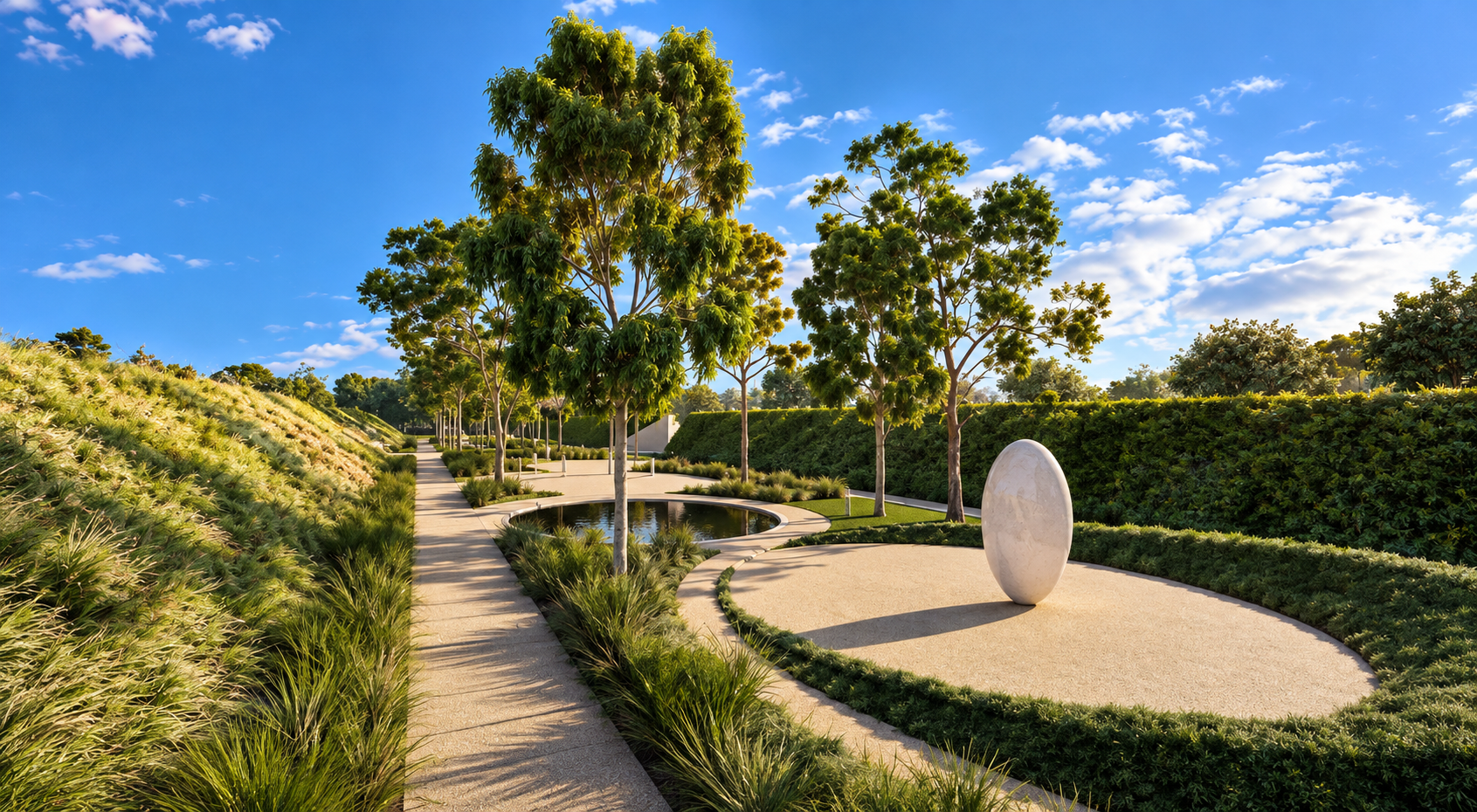
Stage 1A.01 of the Harkness Cemetery masterplan for the Greater Melbourne Cemeteries Trust — a new operations and administration/sales building, ceremonial facilities, major road network infrastructure for future interments, landscaping, early tree establishment and two stormwater detention ponds.
Structuring a procurement strategy and managing a complex, multi-disciplinary risk profile — spanning ground conditions, authority approvals, budget certainty and stakeholder alignment — was critical to achieving a mid-2025 construction start and mature tree establishment ahead of a Q1 2027 opening, on a site with extreme-rated subsoil and authority-approval risks. Delivery was structured into a dedicated Early Works package (tree planting, perimeter swale earthworks and minor civil works) to protect the tree-establishment program ahead of the main works contract, with a criteria-based tender process shortlisting civil contractors against relevant experience, accreditation and prequalification. A detailed procurement strategy memo compared civil-led, builder-led and separate-contract delivery models, recommending a builder-led AS2124 Construct Only structure for Main Works to maximise program certainty and quality control on the architecturally designed ceremonial building.
A live, GMCT-attended risk register spanning Client, Consultants, Design, Program, Budget and Tender/Contract categories tracked and mitigated extreme risks — including geotechnical/subsoil conditions and authority approval delays across Melbourne Water, Powercor, Greater Western Water and Telstra — through a dedicated authorities matrix, while a structured multi-disciplinary comments and RFI register resolved constructability issues across civil and landscape design packages ahead of documentation. The Early Works package was tendered and programmed for construction commencement in July 2025, and the builder-led Main Works procurement strategy was formally endorsed to balance program certainty, quality outcomes and value for money.